
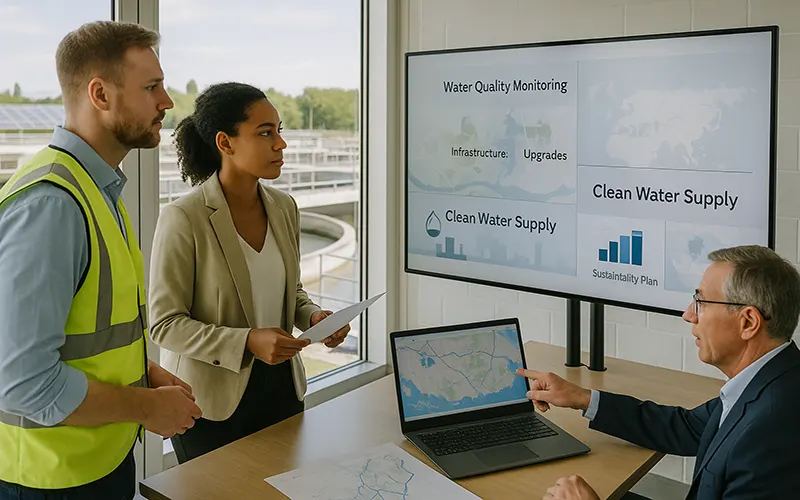
Clean water is the bedrock of public health, environmental stability, and economic growth; it is far more than a simple utility service. Yet, local governments and the utilities they oversee face a severe triple threat: decades-old infrastructure approaching failure, the challenge of filtering emerging contaminants (such as PFAS), and the profound uncertainties posed by increased climate variability, manifesting as alternating periods of drought and flood. Securing a resilient, clean water future requires local governments to deploy a sophisticated, multi-faceted governance strategy encompassing capital investment, sustainable finance, source water protection, and innovative technology.
Strategy 1: Infrastructure Modernization and Asset Management
The vast network of pipes, pumps, and treatment facilities requires an urgent strategic overhaul. Local governments must shift their focus from reactive maintenance (fixing leaks only when they burst) to proactive asset management. This involves implementing rigorous Capital Improvement Projects (CIP) that prioritize the replacement of critical aging components, such as lead service lines and deteriorated distribution mains. This proactive investment is crucial for repairing distribution network integrity and dramatically reducing non-revenue water—treated water that is lost through leaks before reaching the customer.
Furthermore, water safety hinges on a holistic system known as the Multi-Barrier Approach. This strategy defines clean water as a continuous process, protecting it from the watershed to the consumer’s tap. It relies on four sequential barriers: source protection, treatment, distribution integrity, and monitoring. By adhering to this approach, local governments can ensure systematic vigilance against contamination risks at every stage of the supply chain.
Strategy 2: Sustainable Financial and Rate Structuring
Sustainable water infrastructure requires sustainable funding. A core challenge for utilities is achieving financial autonomy to cover the full cost of service—including long-term capital needs and depreciation—without being overly dependent on volatile federal or state aid.
To address this, local governments must implement strategic rate structuring that is both adequate and equitable. Rates must generate sufficient revenue to support CIPs and operational needs. Simultaneously, rate design must incorporate programs, such as tiered consumption pricing and low-income assistance, to ensure equitable access and affordability for vulnerable populations. For large-scale modernization, utility boards must proactively leverage non-traditional financing mechanisms, including low-interest federal programs like the Water Infrastructure Finance and Innovation Act (WIFIA) and state revolving funds (SRFs), which provide the essential financial framework for major long-term projects.
Strategy 3: Source Water Protection and Land Use Controls
The most cost-effective water treatment is prevention. Local governments must prioritize protecting the watershed or aquifer that serves as their source water protection area, as minimizing upstream contamination directly reduces the complexity and expense of downstream treatment.
This strategy requires using strong municipal authority over land use. Tools include zoning ordinances that restrict high-intensity development (such as industrial parks or high-density housing) near reservoirs or wellheads. Furthermore, purchasing conservation easements or land acquisition initiatives can permanently limit development in sensitive recharge areas. Crucially, successful source protection requires extensive collaboration and inter-jurisdictional agreements with upstream local governments and engaging agricultural partners to manage fertilizer and pesticide runoff. This cooperative approach recognizes that water is a shared regional resource, transcending political boundaries.
Strategy 4: Climate Resilience and Digital Innovation
Given increasing drought severity and unpredictable rainfall patterns driven by climate variability, securing supply diversity and operational efficiency is paramount. Local governments must invest in robust water resilience strategies. This includes diversifying the water portfolio through highly treated water reuse programs (e.g., purified recycled water for industrial, agricultural, or eventually potable supplies).
Simultaneously, utilities must embrace digital innovation to manage their complex networks efficiently. Adopting smart utility technologies is key: modern SCADA (Supervisory Control and Data Acquisition) systems, smart meters, and predictive analytics allow utilities to monitor water quality and pressure in real-time, detect leaks immediately, and automatically optimize pumping energy use. These innovations not only enhance security and compliance but also drive down operating costs, making the overall water system smarter and more adaptable to environmental pressures.
Basically, the secure provision of clean water is an enduring commitment that rests squarely on local government strategies. It necessitates integrated planning that cohesively links engineering solutions with sound financial policies and disciplined land-use controls. By proactively deploying Capital Improvement Projects, establishing sustainable rate structuring, safeguarding source water protection areas, and integrating digital SCADA technology, municipal leaders can move beyond crisis management. These effective, multi-pronged strategies are the primary mechanism for preserving public trust and safeguarding the most fundamental resource in the face of escalating environmental pressures.