
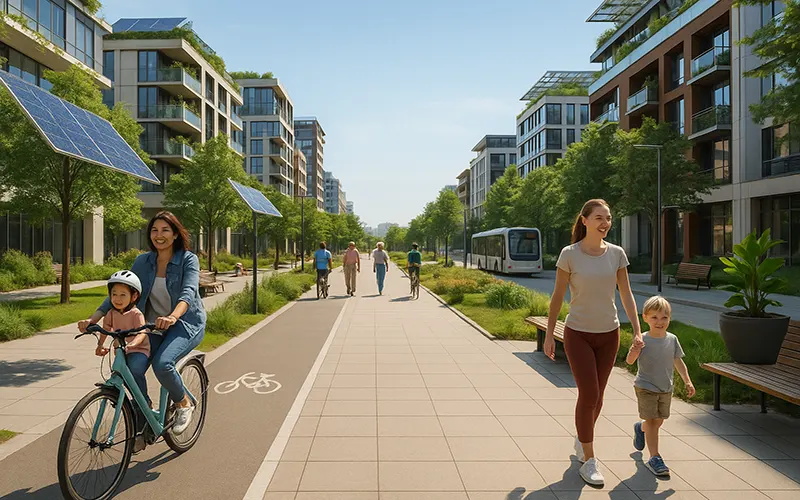
The long-term success of metropolitan areas can no longer be measured solely by traditional metrics like traffic throughput or tax base expansion. Today, the foundational mandate of city building is to prioritize holistic social and environmental health. Sustainable urban planning is the necessary framework that ensures a city’s long-term environmental, social, and economic vitality by consciously integrating human needs with ecological processes. This approach moves beyond simple mitigation, demanding that the very structure of our cities actively fosters human health and community well-being. The contemporary mandate for planning is to create resilient, equitable cities through interconnected design principles that ensure health equity and sustainability for all residents.
Principle 1: Compact, Mixed-Use Development
The legacy of mid-20th-century zoning often mandated rigid separation, isolating residential areas from commercial centers and workplaces. This single-use zoning generated sprawling dependence on the automobile. The first core tenet of modern sustainable design involves embracing compact, mixed-use development, which promotes vertical and horizontal integration. This means creating neighborhoods where residential, retail, office, and light industry functions coexist within a walkable radius.
The well-being impact of this shift is profound. By reducing the distance between home and daily necessities, mixed-use zoning significantly decreases commute times and the associated time spent in traffic, which directly reduces chronic psychological stress. Furthermore, mixing uses creates natural opportunities for social cohesion and spontaneous interaction, fostering vibrant “third places” (cafés, libraries, public squares) vital for civic life. Economically, this model enhances economic resilience by ensuring that residents have proximal access to local jobs and services, simultaneously lowering the substantial household burden of transportation costs.
Principle 2: Prioritizing Active and Public Mobility
A healthy city is fundamentally one designed for people first, with vehicle movement treated as a secondary, managed concern. This principle advocates for a robust network of active mobility options—pedestrian walkways, protected cycling infrastructure, and excellent public transit systems—to serve as the city’s circulatory system.
Prioritizing non-motorized transport yields significant public health dividends. It directly encourages daily physical activity, helping to combat the global rise in sedentary lifestyle diseases. When walking and cycling are made safe, appealing, and convenient through shaded sidewalks, clear signage, and dedicated paths, residents organically integrate exercise into their routine. Beyond fitness, robust public transit provides health equity by offering affordable, reliable access to essential services—jobs, education, and healthcare—for all residents, critically serving those without access to private vehicles. This shift also contributes to a healthy environment by reducing vehicle emissions and localized air quality pollutants.
Principle 3: Integration of Green and Blue Infrastructure
Green and blue infrastructure (GBI) refers to the strategic integration of nature into the urban fabric. This involves developing urban forests, parks, green corridors, bioswales, and restoring natural water features (blue infrastructure) rather than relying solely on engineered “grey” solutions (concrete pipes and flood walls).
The well-being benefits of green infrastructure are multi-faceted. Environmentally, GBI is essential for climate resilience and improving local air quality. Trees and urban parks mitigate the urban heat island effect (UHI) by providing cooling shade and releasing moisture through evapotranspiration. For mental health, the provision of accessible nature exposure, even in small neighborhood parks, has been consistently linked to reduced anxiety, improved mood, and enhanced cognitive function. Furthermore, GBI serves a critical ecological function by naturally managing stormwater runoff, filtering pollutants, and reducing flood risk.
Principle 4: Equitable Resource Distribution
No planning initiative is truly sustainable if its benefits are concentrated in privileged areas. The final principle demands that all investments in sustainable design—safe parks, quality transit access, climate adaptation measures, and fresh food markets—be distributed fairly across all neighborhoods.
This principle directly addresses the historical legacy of discriminatory zoning, which often concentrated pollution, poor infrastructure, and lack of services in low-income or marginalized areas, creating spatial health inequities. By mandating access to urban agriculture programs, linking reliable transit to full-service grocery stores in “food deserts,” and ensuring adequate park acreage per capita in underserved communities, planners actively improve public health and community well-being. Equitable distribution transforms planning from a technical exercise into a moral commitment to social justice, ensuring that resilience and environmental quality are universal rights within the city.
Basically, sustainable urban planning is ultimately a prescription for holistic health. By structurally favoring mixed-use development, active mobility, green infrastructure, and equitable resource allocation, cities can move past being mere places of commerce to become powerful engines of human flourishing. These design principles are the building blocks for creating truly resilient, equitable, and healthy communities for generations to come.